
In today’s rapidly evolving digital landscape, small businesses looking to scale, improve efficiencies and deliver better customer experiences need to adopt Artificial Intelligence (AI). While AI may seem complex, with the right strategy it can provide significant competitive advantages. Below is a step-by-step guide to help small businesses integrate AI into their operations effectively.
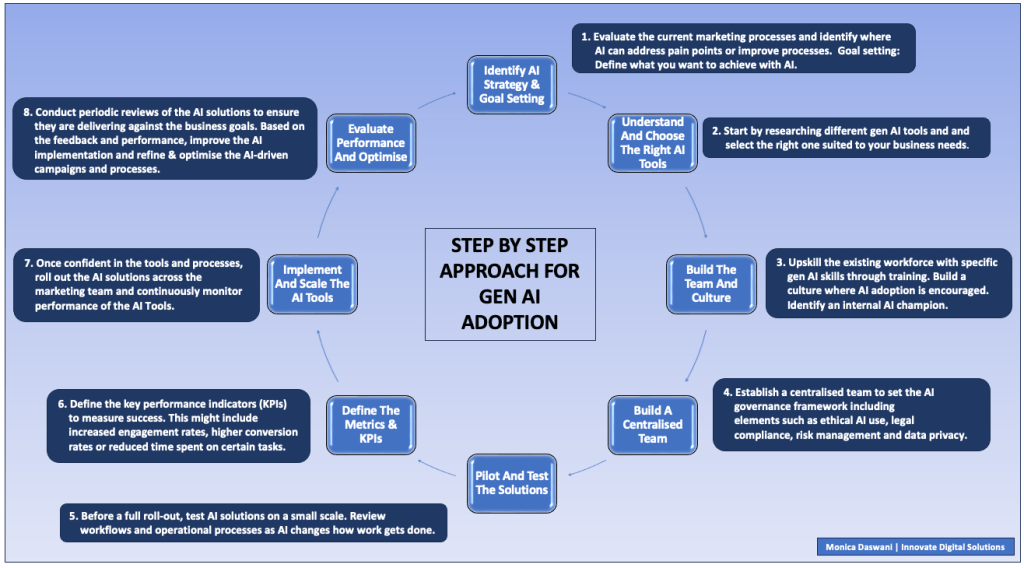
Step 1: Identify AI Strategy And Goal Setting
The first step in adopting AI is to clearly define your objectives. A business needs to start with clear use cases where Gen AI tools can provide real competitive advantage or address specific pain points and have a meaningful impact that is aligned with business objectives. For example, if your marketing team struggles with customer segmentation or personalising customer interactions, AI can be used to automate these processes and achieve better results faster. Other goals might include improving content marketing, automating customer service responses, or optimising spend.
Once the use cases have been identified, it’s best to evaluate them and prioritise based on value, impact and feasibility.
Make sure your AI strategy is aligned with your business goals. Having clear, measurable goals that you want the AI to achieve will ensure that AI solutions not only address specific pain points but also deliver tangible value to your business.
Step 2: Understand And Choose The Right AI Tools
With countless AI tools available in the market, it’s important to choose the ones that best fit your business needs. Start by researching different Generative AI (Gen AI) tools specifically designed for marketing and evaluate them based on scalability, ease of integration, commercial usage rights and cost.
Popular AI tools in marketing include platforms for automated content creation, AI-driven email marketing and customer behaviour analytics. Test different tools and select those that address your primary business pain points while fitting within your budget.
Step 3: Build The Team and Culture
One of the most crucial elements in adopting AI is ensuring that your team is well-equipped to manage and maximise AI tools. Start by upskilling your existing workforce with AI-specific training. Employees should not only know how to use the tools but also understand their limitations and ethical concerns. This ensures responsible and effective AI usage.
Establish a culture that encourages innovation and creativity. Identify an internal AI champion who understands AI well and can support and inspire others to adopt the technology. This person can play a vital role in helping your team transition smoothly into AI-enabled workflows.
Step 4: Build A Centralised AI Team And AI Governance
To ensure consistent deployment of AI solutions, establish a centralised team that will set and oversee the AI governance. This team should handle the creation of an ethical framework for AI use, legal compliance, risk management, and data privacy. Their goal should be to ensure that AI solutions are deployed safely and responsibly across different departments.
The centralised team should collaborate with cross-functional teams to provide the necessary tools, guidelines and support needed for seamless AI adoption. Additionally, this team should stay informed about the latest AI advancements and legal regulations, relaying crucial updates to the relevant stakeholders and teams.
Step 5: Pilot And Test AI Solutions
Before a full-scale implementation, pilot your AI solutions on a smaller scale. For instance, you might test AI-powered email marketing on a single customer segment or trial an AI tool for content creation. This will allow you to assess how well the AI solutions integrate into your existing processes and identify any operational changes needed to improve workflows.
Piloting gives your business the opportunity to review and refine the technology before committing to a large-scale rollout. Additionally, it allows you to gather feedback, adjust strategies and troubleshoot potential problems early on.
Step 6: Define The Metrics And KPIs
To measure the effectiveness of AI tools, it is essential to define Key Performance Indicators (KPIs) that align with your business goals. KPIs might include metrics like improved customer engagement, higher conversion rates, or reduced time spent on specific tasks.
Clearly defining these metrics ensures that AI tools are adding value and helps you measure progress toward your overall business goals. Additionally, having well-defined KPIs allows for continuous tracking and fine-tuning of AI implementations.
Step 7: Implement And Scale AI Tools Into Operations
Once you have tested your AI solutions and are confident in their performance, it is time to implement them across your operations. Begin by rolling out AI solutions within your marketing team, ensuring that they are trained on the tools and understand the new workflows.
Monitor the performance of AI tools regularly and make adjustments as necessary to keep up with changing business goals and market conditions. Always maintain open communication channels for team feedback to ensure the technology is helping rather than hindering their work.
Step 8: Evaluate Performance And Optimise
Adopting AI is not a one-time process—it requires continuous monitoring and optimisation. Regularly review the performance of AI solutions to ensure they are delivering against your business goals. Based on these evaluations, refine your AI strategies and optimise your campaigns and processes.
Optimisation might involve adjusting the tools, expanding their scope, or training staff on new features. Continuous improvement will help ensure that your AI-driven initiatives remain effective and relevant as your business grows.
Conclusion
Integrating AI into a small business’s marketing efforts can help your operations by streamlining processes, improving customer engagement, and driving business growth. By following a step-by-step approach, small businesses can maximise the benefits of AI while minimising risks. The key to successful AI adoption lies in defining clear goals, selecting the right tools, building a supportive team culture and continuously optimising your AI-driven initiatives. AI can be a powerful tool to help small businesses compete in the digital age.
Adopt AI today and stay ahead of the curve in the competitive marketing landscape.

