
When starting to put a digital marketing plan together, knowing where to start can be the hardest part often.
For the overall structure of the plan, the SOSTAC® framework developed by PR Smith, author of the Digital Marketing Excellence has been recommended as a good framework. SOSTAC® is a strategic planning process framework that gives a clear structure to work through to create and manage the plan and is relatively simple and logical to use.
SOSTAC® stands for:
- Situation analysis – where are we now?
- Objectives – where do we want to be?
- Strategy – how do we get there?
- Tactics – how exactly do we get there?
- Action – what is our plan?
- Control – did we get there?
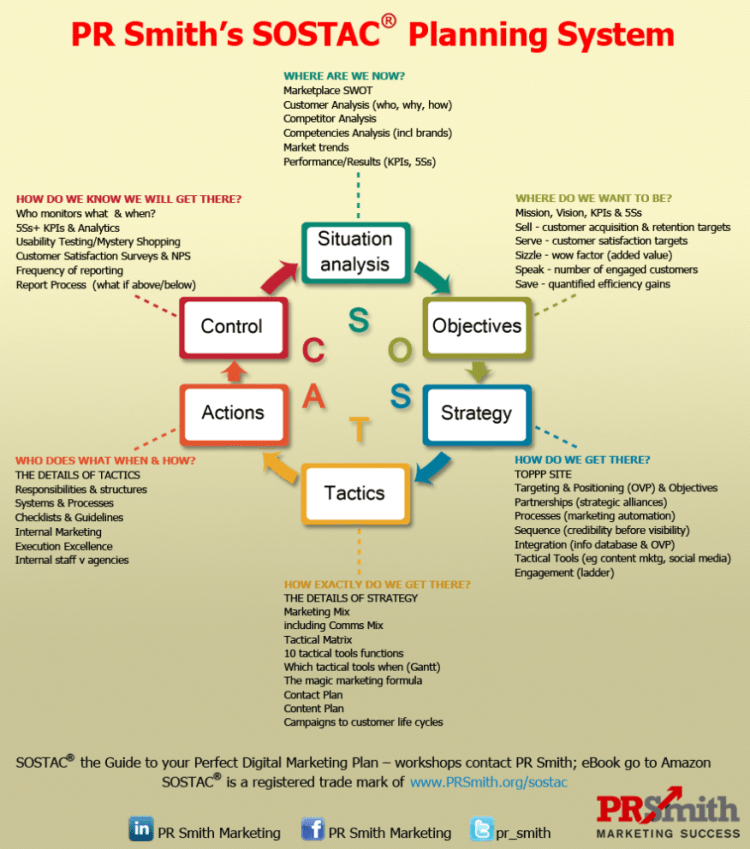
Each of the steps mentioned above will be considered in more detail in the next section:
Situation Analysis
The first stage of the SOSTAC® is the situation analysis. The situation analysis is an overview of your business. This helps you understand where your business is currently so that you can draft the strategy for the future.
Some key components to delve into in order to understand the current situation of your business are:
- Customer analysis: The customer analysis helps you to get a good understanding of who your customers are so that you can identify which segments you want to target as part of your marketing plan.
- Competitor analysis: Who are your competitors? Where do you stand in front of the competition? What advantages do they have over you to compete and what advantages do you have over them?
- Environmental analysis: This will include external factors such as economic, political, social, technological and environmental trends and their possible impact on your business
- SWOT analysis: Combined with your findings from the environmental analysis, you can look at a SWOT analysis which is strengths, weaknesses, opportunities and threats which may affect your business. Also, internal factors such as resources, capabilities and financial costs need to be taken into account.
Objectives
The second stage when putting together a marketing plan is objectives which means ‘Where do we want to be?’. This includes the long-term objectives such as the vision and mission of your marketing strategy as well as short-term objectives such as the 5S goals defined by PR Smith as below:
- Sell: Grow sales and market share.
- Serve: Add value to what you offer the customer.
- Sizzle: Stickiness and the wow factor.
- Speak: Two-way communications with customers.
- Save: Quantifies efficiency gains.
Each of the 5S goals must be SMART – Specific, Measurable, Achievable, Relevant, Time-bound – to be effective as suggested by experts in the field.
Strategy
Strategy means ‘How do we get there?’. Strategy summarises how to fulfill the objectives. Here it is essential to make clear things like how you plan to divide the market, which customer segments you should focus on, what message should you use to target each segment, and how your plan compares to that of the competition.
Tactics
Tactics are the details of the strategy (the marketing mix, communications mix and the channel mix are the tactical tools). They highlight on a campaign timeline exactly which tactics occur when.
Action
Action relates to the planning implementation of the strategy i.e. what is our plan? This includes the project plans for strategic digital initiatives and detailed plans for different tactics such as editorial plans for content marketing.
Control
Control means ‘how do we monitor performance?’. Control is needed to ensure the plan stays on track to achieve targets. Monitoring progress is also an important step. It involves reviewing performance against target using digital marketing dashboards and putting corrective actions in place.
 Innovate Digital Solutions